top of page
  • Oct 6, 2023
  • 4 min read

More Than Dumbledore

Last week, like countless others, I was moved by the death of Michael Gambon, a British actor who did amazing things onstage and off. As his obituary headlines poured in, I noticed they almost uniformly mentioned him first and foremost as the second Albus Dumbledore in the Harry Potter franchise of films. This he was, taking over from the deceased Richard Harris. He made Dumbledore his own and provided some of the more interesting and reflective moments of Goblet of Fire and Deathly Hallows—Part 2. If someone has been involved in a current franchise craze, Marvel or otherwise, and passes away, they are noted for their appearance in high-grossing films rather than the majority of their work otherwise.


But Gambon was so much more than Dumbledore. A staple of the theatre community, he acted marvelously all his life and made many more movies than the Harry Potter film series. This “soundbite obit” phenomenon of linking artists with not their best but they’re most commercially successful efforts harkened back to an X-post I had seen a few weeks ago mourning that most of the official obituaries of the late novelist Cormac McCarthy had mentioned the films made from his novels more so than the novels this prototypical novelist wrote. He opined something like, “Who cares what movies were made from them? The man was a novelist; that’s how he should be remembered.”
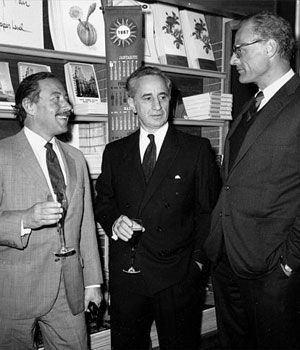
Williams, Elia Kazan, Miller

The American theatre has this problem too. Judging by the obituaries, American playwrights are only known for one work. I knew when Arthur Miller died, the obits would read “Death of Author of Death of a Salesman” while Miller wrote many other great plays (at least between 1944 and 1964), including The Crucible, which may be the great American play. Tennessee Williams, likewise, was (according to obituaries) famously known for A Streetcar Named Desire (maybe also Cat on a Hot Tin Roof) and the film versions especially. Now this is understandable to agree. More people in the world go to the movies than the theatre. More people go to the movies than read books. But this franchise frenzy we find ourselves in now? If Michael Fassbender were to unexpectedly leave us, would he be known for his Marvel movies or some of the more penetrating and moving performances of our time?

More than one play

Oftentimes obituaries pave the way for the manner in which an artist is remembered. Eugene O’Neill has somehow been relegated to this idea that he wrote a good deal of plays and eked out one masterpiece before he died, Long Day’s Journey into Night—that one written long after he had won the Nobel Prize in Literature and had given American theatre a voice—the voice of a master, the voice of an authentic American dramatist, whose Iceman Cometh may end up being seen as the better play.


Our concern with mourning the artists we lose has reached a fever pitch. Indeed, we have lost so many since COVID, not just a result of that disease but a baby boomer generation dying out, and we heap on the most financially successful of their endeavors. This may be appropriate when considering Paul Reubens, a man who was (for all intents and purposes) known only really for playing Pee-Wee Herman. But Gambon deserved better. I could scarcely take my eyes off him when seeing him in Conor McPherson’s film version of Samuel Beckett’s Endgame and, even in tiny roles—like that of the film mogul in The Life Aquatic with Steve Zissou—he was a presence to be reckoned with.


Sure, once you click the link, it might mention his other work. But should Alan Rickman and Robbie Coltrane be known as Potter characters when they both carved out their own niches in a country brimming with top-tier actors and gave us many more memorable performances? Will they deign to make Harry Potter part of the headline for Dame Maggie Smith’s passage (may it be many years away)? Or will they acknowledge one of the great actors of our age, whether she participated in Potter or not?


Are journalists and readers so itching for clickbait that they will reduce an artist’s career to one major work just to get views? Is it the journalists or simply the editors (who, after all, often rename pieces of journalism)? When Robert Altman died, I don’t remember obits about the man who made M*A*S*H or Nashville, but a man who nearly made forty movies, some of them not so great, but what can you do?


For the love of Pete, our artists deserve better tributes to their memory than just having participated in Harry Potter or the MCU. They are not given obituaries in major papers because of one incident in their lives, which they were most likely drawn into because their grandkids would be mad at them if they didn’t. If that were their only claim to fame, one would get it, but that’s just not the case.


If franchises are what you’re about—if you crave the new serial from these fan bases—good for you. But know the artists involved are people whose accomplishments are far greater than the world of Young Adult, or even Child, Fiction that you should have stopped reading years ago in favor of something nourishing to your adult soul.


“Well, how many characters do I actually have in an obit headline?” I don’t know, but “Michael Gambon, great actor” would have been sufficient. The people already know his image, so let them read the bloody article and find out more about the artist who inspired them. Open their world. Open your world to new information.


A man with nearly 200 credits in film and television, not to mention his radio and theatre performances, deserves better and so do you. It’s a shame we live in an age where journalism is what it is: mouthpieces for gatekeepers of one shape or another. But we owe our ailing and deceased artists more than pity and boxes to keep them in.

Endgame


  • Sep 29, 2023
  • 8 min read

Yes, I am a poet (playwright),

two hundred years too late…


I was born with the umbilical cord wrapped around my neck, choking me. When I made it out alive, on first sight of my father, I urinated all over him. That’s the way I began. I was the most planned-for child ever in existence. My brother, 15-years-old at the time, requested me. And a sibling he was given.

I was born to a salesman who was often gone before I awoke and home after 6pm. He was a very funny man, who turned down college to go on and make a living in the world even though he was academically brilliant when he graduated high school. He was a wonderful father. My mother was/is a cosmetologist who took her GED and went to beauty school, eventually marrying a man ten years her senior about whom she once said, “I will never marry that man!” A whopping 53 years they lived together before Dad’s death. My brother was an outside guy—athletic, hard-working, had a different girlfriend every week until he married at age 26 to a lovely woman. He became a fireman after realizing he couldn’t be kept inside. Has done it a quarter century.


Those are the plain facts. In an area where everybody was encouraged to play sports, my mother and father took a liking to my adeptness at mimicry, joke telling, and impersonations. My mother began to have dreams of sending me to the Alabama School of Fine Arts (ASFA). Ever since age 5, I dreamed of being in the movies, but I switched to the theatre upon entering ASFA. But that leaves part of the story out.


I was raised in a private Baptist school and was baptized in the Southern Baptist Convention when I was eight years old. A highly religious child, I began even then being enthralled by elements of the old world. Theatre eventually became a part of that as itself began as religious rites. But my love of history (my favorite early school subject) and my distaste for people my own age (I always aspired to be forty; I have made it, have no opinion yet) set me apart. I’ve grown religiously from my beginnings, but I would still consider the Baptist Hymnal to be a real influence on my life.


I was a child who always wanted books near me but could scarcely get through one. I’m certain if I’d been born a few years later, I would’ve been put on medication for something for my reading comprehension was poor and my one claim to fame on the left side of the brain is a healthy degree of skepticism and an A+ in Algebra II, seconded only by my constant and incorrigible 75 average in Geometry.


I began life in a private school in a cul-de-sac neighborhood with very few children nearby. I didn’t get on the school bus; I was driven to school. I remember my childhood as being largely solitary because even my brother was rather physically exhausted by school athletics and was an adult by the time I turned three. I turned inward, voicing my puppets and action figures all the while Dad recorded my “home movies” on a very early, very expensive VHS camera.


My inner life became important to me as I had to imagine school as a seven-hour television show that I was starring in. School it was called, and my best friends were the co-stars, my arch nemeses the “also starrings,” and my current love interest was given a special “and” title. My first friends were all girls, but I was an early bloomer and, as soon as the libido started working, my best friends were guys and women became something else.


As I was nearing forty, the question of a woman in my life was the most pressing thing on my mind. I know several of my friends on their second marriages, my young nephew has married before me—and I remain straight, but unaffiliated. Of course, the woman who would be interested in me would have to deal with various inconsistencies: that I am, on the hand, extremely religious, but also like my fair dose of the profane being the one closest to mind.


There is a story of me as a baby where I cried for a straight twenty-four-hour period. My parents tried everything—food, diaper changing, toys. Nothing worked. Finally, Mom closed the door to my room, leaving me in my crib and the crying stopped. She peeked in and I was entertaining myself by watching whatever gadget hovered above me. There is a very real part of me that wishes to remain alone, but in the wee hours, I wonder how much my life would have been different if any of the objects of my affection had said yes or the ones who did would have changed it if I had stayed.


At any rate, I never knew how courageous I could have been in that department. I was born with a confidence that most mistook for cockiness and likewise made me a bookworm to try and gain that intellectual status people thought I had, but only aspired to. But, as for women, the confidence wasn’t there. I felt defeated by them and there was also something a) about how creativity is sparked when you’re in love and b) how creativity is sparked after coming out of that daze: a rather different creativity can show its face, potent also.


As a practicing dramatist and poet, albeit two hundred years too late, I can rarely write plays not in love. But poems come bounding out in the spaces between these one-sided rendezvous. So, I must be grateful for the gift of both. The gift of occasionally being in love and a woman deigning to spend a little time with me and the time alone where I can pursue my interests unheeded.


My teens are a blur. I was a practicing actor, studying at ASFA, in one show after another. There was no time for adolescence. I knew there was drugs and drinking and smoking around, but I didn’t partake. I was up on a career ladder, which became very unshaken and uncertain by the time I left college.


On reaching my twenties, I was rather comfortable—I knew I wanted to be a playwright, I was in a stable relationship, but I was bored. I don’t know why, but I was bored. Near the end of every chapter of my life, I consider dumping everything I’ve done and trying something new. At the end of high school, I considered studying theology (which, eventually, I did do as a graduate student); at the end of college, I considered throwing my laptop of plays in the nearby like and starting fresh or going to law school. I considered these things, but there remained a through-line—a writer trying to understand himself through his work. I suppose that’s all it really is, even if this might seem a bit glib.


My twenties turned into an awful morass. I was the prototypical millennial—I went into the real world, unprepared for it, and ran back home, screaming. It didn’t help that the bubble burst a few years after I graduated college, and the times were hard. I could have just as well roughed it (in New York, say), but I didn’t. I went into the time of self-analysis that should be the prerogative of teenagers. With our generation, everything was mixed around. People started saying your twenties were the time you should experiment and try to let stick anything on the wall that will, but this isn’t true and is, in fact, dangerous to one’s development because we only have so much time down here, you know?


Thirty was another milestone. After another degree, and a half-hearted attempt at a career in public education, I realized most everything I had ever thought was wrong or misguided. That’s what thirty does to you. As a kid, I loved old movies and music, but when I tried to watch Lawrence Kasdan’s The Big Chill, or tried to listen to a song of Neil Diamond, I was bumfuzzled. At thirty, it all made sense. I could explain more, but I won’t as my thirties were full of heartbreak, though they ended with some sense being knocked into me as I became a caretaker to a dying father and had to start looking toward the future.


The last couple of years have been good—perhaps not this one, but that’s because forty was looming. My father locked himself in a room for a week when he turned forty. I did this as twenty-two, so I guess I matched him on a different plane; I just had what the millennial generation ushered in: a quarter-life, as opposed to, mid-life crisis.


Since turning forty, I’ve had no desire or time to lock myself in and/or waste any more time. I must celebrate writing something to publish every week on this blog. I must celebrate a life that could have been aborted twice, with my then self-inflated sense of doom. I must be thankful to be alive and continue.


Before Jimmy Buffett died, I already had the title to this piece, though I hadn’t written it. His song about a drug smuggler, “A Pirate Looks at Forty,” is cogent to the argument. There are many things to mourn about being forty now. This is not a complaint, but 80% of the prizes, awards, contests, and submissions I can submit my work to are no longer open to me. One must be BIPOC or LGBT to get a hearing in the theater or in poetry nowadays. I’ve had my fair share of publications this year, but I consider them flukes, based largely on blind juries.


I cannot help what I am and yet I must live on, doing what I believe I was put on Earth to do. So, there are still some plays to finish, one was finished this year—There Will Always Be a Fire—and some poetry I wrote many years ago has finally had a hearing in a couple publications. For that, I am grateful. But, if God is willing and the creek don’t rise, I could be around for thirty or thirty-five more years, and I would like to see some dreams come true. Everyone deserves it, regardless of their color or other particularities.


I have watched the same two stupid political parties have the same arguments repeatedly. I have watched the film industry turn into a franchise machine. I have watched the decline of the novel, except for the Young Adult variety which are all too often read by people who should be reading something that matches their age. I have seen the theatre also turn to franchises to keep afloat. I’ve seen six Presidents come and go and each is stupider than the last. I have always voted my conscience, never prescribing to one ideology or another. I have loved and been loved. I have eaten and fasted. I have had times to mourn and times to rejoice.


What’s better than that? Does the alpha male who has three children and a mortgage have a better life? How would I know? Does the Yankee or Midwesterner who believes they can leave their home ground and create different families in New York or L. A. live better than me? How would I know? Would my life had been different if I had settled at any time? How could I be sure? Do I want to be sure? Or should I realize my life has been, at least at times, extraordinary? That I have touched people. That I have loved more than I’ve hated. That I have given more than I’ve got.


Yes, I am a poet and playwright two hundred years too late. People like me always believe they would have done better in another century, another time. Who’s to say who’s right in this regard?


What does a writer do at forty? He continues to write. I shall pursue this, even if the dreams always remain at bay and I encourage the same to all you dreamers.


More love. More joy. More dreaming, even if it seems pointless.


All photographs, save the last image, appear courtesy of Steven Ross. For more information about his work, visit his website.


The odds were stacked against us for opening weekend. It was the start of college football and Labor Day weekend and yet, as we approached the opening, the seats were filling up. Dutifully, I kept tabs on the Birmingham Festival Theatre (BFT) website, checking to see how ticket sales were going. I thought, for a weekend with so many things stacked against us, playing to crowds of 15-30 was pretty good, especially since I had seen BFT’s opening show of their 50th season, Paula Vogel’s How I Learned to Drive with an audience of only three others, including the usher.

Opening night, we gathered at 6:30 and put on our full costumes, still stinking from the Final Dress Rehearsal. Already my main memory of performing Waiting for Godot is sweating for two and a half hours, so much so that makeup was out of the question as it would have done nothing but stain our shirts. Places were called and, as far as memory carries me, it was a performance filled with a good bit of laughs. One among them was my mother, who I was most afraid would chastise me for putting her through it. In her own words, once she realized it could be seen as a precursor to Seinfeld (a show famously but wrongly about nothing), she enjoyed herself immensely. Over the course of the three weekends, most comments given to me were for my facial expressions which, in themselves, were exhausting. Gogo goes through highs and lows, quick changes from levity to depression. He played me like a fiddle.

Even as a child actor, I detested going out to see the audience after a show. But, as my mom and her friend were there, I went out and found the remnants of a surprisingly satisfied crowd. The only negative murmuring I heard that night was one audience member who mouthed, “Jesus Christ” a few times. Well, you can’t win ‘em all and Godot is definitely not for everyone.

The Saturday evening performance was, for me, a sadder one, but still a well-received show. Laughs were plentiful, but I found myself pretty spent at the end. Afterwards, all I could do was sit in the dressing room, staring into the mirror. I could see what the play was doing to me. My eating habits had been horrible, my exhaustion palpable. I looked at a face I hadn’t seen in a while—spent, riven, distant. The director, who I had made up with after our kerfuffle kept encouraging me for this not to be my last show. But, that night, I saw the actor in me again and I didn’t care for the sight. I had been getting depressed during the rehearsals, steadily, and I was ready for it to be over.

Sunday came and the audience was eerily quiet. We got nothing. Maybe some light nose-laughter that gives you nothing with which to play. During intermission, we commiserated as to whether this was the result of a post-lunch food coma or whether they were seeing more of the tragedy than the comedy in this tragicomedy. But much to our surprise, we got a few standing ovations after the performance. So, they clearly appreciated it, but were just a different kind of audience, more contemplative, I suppose. Who really knows?

We got three much-needed days off from the show before arriving on Thursday night for a line pick-up rehearsal with the Production Coordinator, the lovely Virginia Sardelis. She reminded us of the parts of the text we would probably never put in the show as we had memorized it without them, but with her help, we were able to restore some bits that had been absent on a nerve-jangling opening weekend. I knew that the majority of people I knew would be coming the second weekend. Every one of my coworkers on Friday night, an estranged friend on Saturday, and my church family on Sunday. So, I felt the pressure, but it surprisingly didn’t get to me.

My true surprise was that the stage fright I had only ever experienced with my last show, seventeen years ago, was nowhere to be found. Each performance, Cliff Spencer (Didi) and I would shake hands or buck each other up and I went on, just ready to go. Perhaps I’ve changed. Perhaps that one bit of stage fright doing Screwtape was just a blip in my acting repertoire—who knows? My coworkers stayed after Friday night and wanted a picture with me on the stage, which the theater allowed. They are all supportive, lovely people. Also present was my brother, his wife, and one of his sons and hiswife. They were all a little more non-plussed. These are sports fans, not theatre goers. My brother’s one comment was, “We’ll have to talk later about the meaning. Seems Biblical.” I’m not sure I have anything deeper to offer. I still don’t understand Pozzo and Lucky and I still think Endgame does what Beckett did in Godot better, deeper—bleaker yes, but that one’s the masterpiece.

Saturday evening brought it with it another audible crowd. I recognized the laugh of my former collaborator in the audience. I, at first, hesitated to go outside and see him, but as he is also friends with Ray Cole (our Pozzo), an awkward after-show encounter ensued. That’s all I have to say about that. The second weekend’s Sunday audience was entirely different from the last—ready to laugh, ready to go with it. My church family were equally supportive. They had sent me off from potluck with good vibes and the show went off without a hitch. It’s funny—I thought I would remember more sitting down to write this, but in a run memories bunch up and you only really remember when you screwed up or on nights where people you know are in the audience.

Another three-day break. Another Thursday line rehearsal where we pinpointed lines we’d still missed each performance (I hope the Beckett estate aren’t reading this). But overall, I was impressed with how much of the material we continued to absorb and even add in after the fact. I don’t remember much about the Friday show. Saturday’s show, on the other hand, was significant as we dropped maybe three or five minutes’ worth of Act II material—easy to do in a show where lines in both acts are similar. If one wasn’t careful, you could start doing Act II in the middle of Act I.

Afterward, however, I was greeted by a current student at my alma mater, ASFA, who was appreciative of my work. They are apparently studying Godot (so many more of his classmates should have been there). A nice young man, his feedback greatly appreciated.

The next morning, I combed the house looking for end-of-show presents I could give to the cast. I had always intended on giving them some of my written material. I was feeling more and more like a writer caught in an actor’s nightmare. Over the course of these weeks, I’ve gained weight, I’ve let Godot’s tragic side affect my life, my daily work, and all writing (save these blog entries) had ceased. So, I wanted to give a true part of myself to the actors.

Before the show, Cliff and I talked about how we both wanted to savor the show and also were ready for it to be over. It had been exhausting. Drenched in sweat at the end of each act from the sheer physicality of it, I’m sure we displeased every audience member with our rankness when we went out to greet them. Again, I mostly remember how my costume stunk and how Cliff’s stunk and how I had to eat carrots each night that were stuffed in Cliff’s suit pocket. It’s amazing I haven’t contracted anything.


So, what to say of Godot? It would have been probably an entirely different experience in January and February when it was supposed to play. Certainly, back then I had a job that was less mentally taxing, I was in better shape, I was game and ready. Since April, this slowly approaching 40th birthday has been messing with me existentially and Godot didn’t help that at all with my character’s talk of hanging himself.


I am glad I did the show. And I’m not glad at the same time. Some experiences are good with no asterisks. Some make you contemplate life and the decisions you’ve made. Some remind you of the rut you might find yourself in as you look in the dressing room mirror.


As with Keke, I had alluded to much of the cast and production team that this would most likely be my last stage performance. As I left closing day, Virginia—our unofficial “stage manager” in our line rehearsals—also encouraged me not to. And that day, there were more random audience members who were complimentary to my performance. Again, their responses remind me of what Terry Gilliam said to John Cleese when they met—“I like the faces you pull.” But then, the audience members go home, and you go home and you never really know if you had any affect at all.

I can never know what play they felt they saw. I know I saw a more energetic Beckett (that was still reverent) than most productions, either videorecorded or the one I saw at the University of Montevallo many years ago. It was certainly fun working with my friend Ray. It was wonderful to watch Sydney and Tank in their parts. It was an immense pleasure to work with Cliff—he was fantastic from day one and I hope I did well by him. And I hope to work with him again, albeit in some different capacity. Still: time to let Godot go (he’s not showing up anyway) and move on.


The theatre is such an ethereal world. It’s all over now. BFT is moving on, finally, to their fifty-first season, and I go back to the daily grind. This will be my first real weekend in quite a few months—one with no distractions except the little critters that roam around the house, bossing me around.


I hope it’s healing, but with that birthday Sunday, I worry it will be full of regret and, next week, we’ll reflect on turning forty here on the blog. Hope to see you back.


Thank you to those who came to the show, thank you for those who followed the blog posts chronicling the experience.


Dear acting, you have broken me physically, somewhat emotionally. I still love and hate you. I hate rehearsing and learning lines has become a nightmare. And yet I love performing for people and we had consistently strong crowds, even on one particularly rainy night.


Never be ungrateful for rain. Or for any opportunity, for that matter.


ryanctittle.com

  • alt.text.label.Facebook
  • X
  • Instagram
  • Youtube

©2022-2026 Ryan C. Tittle

bottom of page