


Review of MONSTER: THE ED GEIN STORY

*out of ****
I’ve recently been re-watching Ryan Murphy’s series from the middle-00s, Nip/Tuck and, I can’t believe I’m saying this, but as salacious and exploitative as it was, it is tame compared to the places Murphy’s imagination will go these days. Ever since it premiered, the anthology series Monster has taken a true crime deep-dive into famous cases of murder from serial killers (Jeffrey Dahmer) to high-profile cases such as the Menendez brothers. In its third season, the attention is focused on Ed Gein, the Butcher of Plainfield, who was the inspiration for Norman Bates (Psycho), Leatherface (The Texas Chain Saw Massacre), and Buffalo Bill (The Silence of the Lambs) among others.
While the Dahmer series was extremely well made, it set a precedent for the wildly free ranging plotting of these mini-series, which act like they have non-existent attention spans and no sane mind to reign them in from all their excesses. The Ed Gein Story is the worst season thus far; while currently #1 on Netflix, the critics have reached a consensus on its artistic merit (or lack thereof): it’s a head-scratching stinker.
Written by Ian Brennan and directed by Max Winkler, the eight-part series is only partially about Gein and his heinous activities, which were fueled by the loss of his mother; the rest is mostly about the explosion of true crime interest and serial killers after World War II. We are taken to Hollywood as Alfred Hitchcock casts Anthony Perkins in the role that would pigeon-hole him for the rest of his career, Texas as the indie filmmaker Tobe Hooper produced the terrifying story of cannibalism that was a reflection of the nation in the mid-1970s, and (strangest of all) to Nazi Germany where Ilse Koch (the “Bitch of Buchenwald”) inspires Gein’s interest in creating furniture out of his victims.
The series plays fast and loose with the facts, pinning every unsolved murder case in Wisconsin on Gein despite him only confessing to two murders (the rest were dug-up corpses) and adding perhaps the worst character I’ve seen on TV in many moons—a love interest for Gein who shares his predilection for true crime and even fuels his interest by bringing him photographs of the Shoah. It also, like the Dahmer series, finds a way to suggest Gein should be empathized with as he becomes the person who solves the Ted Bundy case, Hannibal Lector-like, and suffers from schizophrenia, which while true does not excuse his crimes.
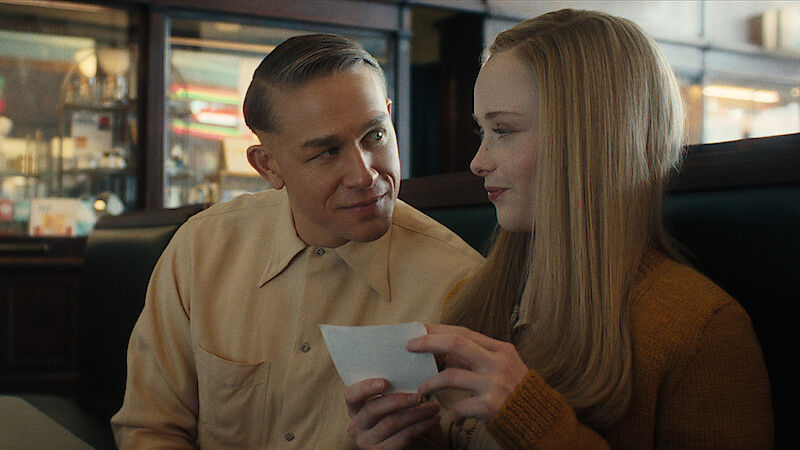
Charlie Hunnam plays Gein, the mentally deficient man-child with mommy issues and a penchant for dressing in women’s clothing. The physical resemblance to the real life Gein is perhaps the scariest aspect of the show. Suzanna Son plays Adeline, Gein’s love interest, and Laurie Metcalf plays Gein’s mother. While always technically proficient as an actor, the talents of folks like Metcalf are wasted in the series, whose gross-out gore factor registers off the charts.
The weaving in and out of various storylines was one of the few things that worked in the Dahmer season; here, Brennan throws darts in multiple directions and with no artistry whatsoever. It is pleasing to see Tom Hollander take on Hitchcock though these sections of the series are necessarily skimming the surface of the material. Since this is well-traveled territory in film lore, they feel like whole chunks of Cliff Notes pasted into a clumsily written paper.
While Ryan Murphy was not directly involved with this season, his imprimatur is all over it. I asked last year what kind of sick mind would even want to make a dramatic effort out of the Menendez brothers case. Murphy is, at times, gifted, but this is overshadowed by his more prurient interests that are saturated in this age’s craving for the bloodiest true crime possible. While the series eventually asks the question why, there is no good answer. By the time you get to Richard Speck and his admirer Bundy in the final episode, you are so hungover from the sick, the twisted, and the bizarre, you only wish to take a bath.


Comments